At OLS we love working with other communities, so when the opportunity to run a workshop for the eLife Community Ambassadors program came up, we didn’t hesitate to jump into the collaboration. In this post, we share what the workshop was about and how it aligns with our Seeds to Systems strategy.
eLife & OLS
The links between eLife and OLS are not new. In 2019, both communities took part in Mozilla’s Open Leaders X initiative, a train-the-trainers programme that supported them in building their own open leadership programmes. In the case of OLS, this process led to the launch of the first cohort of Open Seeds. For eLife, it led to the implementation of a cohort of their Innovation Leaders initiative, which ran during 2020 and complemented their Ambassadors programme.
Running since 2017, the eLife Community Ambassadors programme brings together early-career researchers and supports them in driving positive change in research culture within their communities. As part of the programme, Ambassadors participate in a range of training activities designed to develop skills in areas such as research reproducibility, open science, equity, diversity and inclusion (EDI), and science communication. And in a context of shifting funding priorities, these skills increasingly overlap with the ability to secure support for initiatives working towards open and reproducible research, an insight that also underpins OLS’s strategic direction for the next five years.
Drawing on ongoing research on the leverage points that can enable opportunities for community and project sustainability, as well as projects developed at the 2023 and 2025 DISC Unconference, we shifted the focus of our initial workshop proposal from grant writing to grant readiness: a broader set of skills that precede or complement grant writing, preparing researchers to apply for funding in the first place.
Piloting a grant readiness workshop
With that approach in mind, and considering that this was a three-hour workshop for early-career researchers with very different lived experiences of applying for grants, we split the workshop into three sections.
In the first part, the focus was on drafting a mental model of the current funding and grant readiness landscape. We gave an overview of what is funded and who funds it, what the grant application processes usually look like, which parts involve actually writing something, and what other activities can help make you more prepared for the process. One of the key ideas we wanted to convey is that there is not one funding scheme that will solve all your project needs.
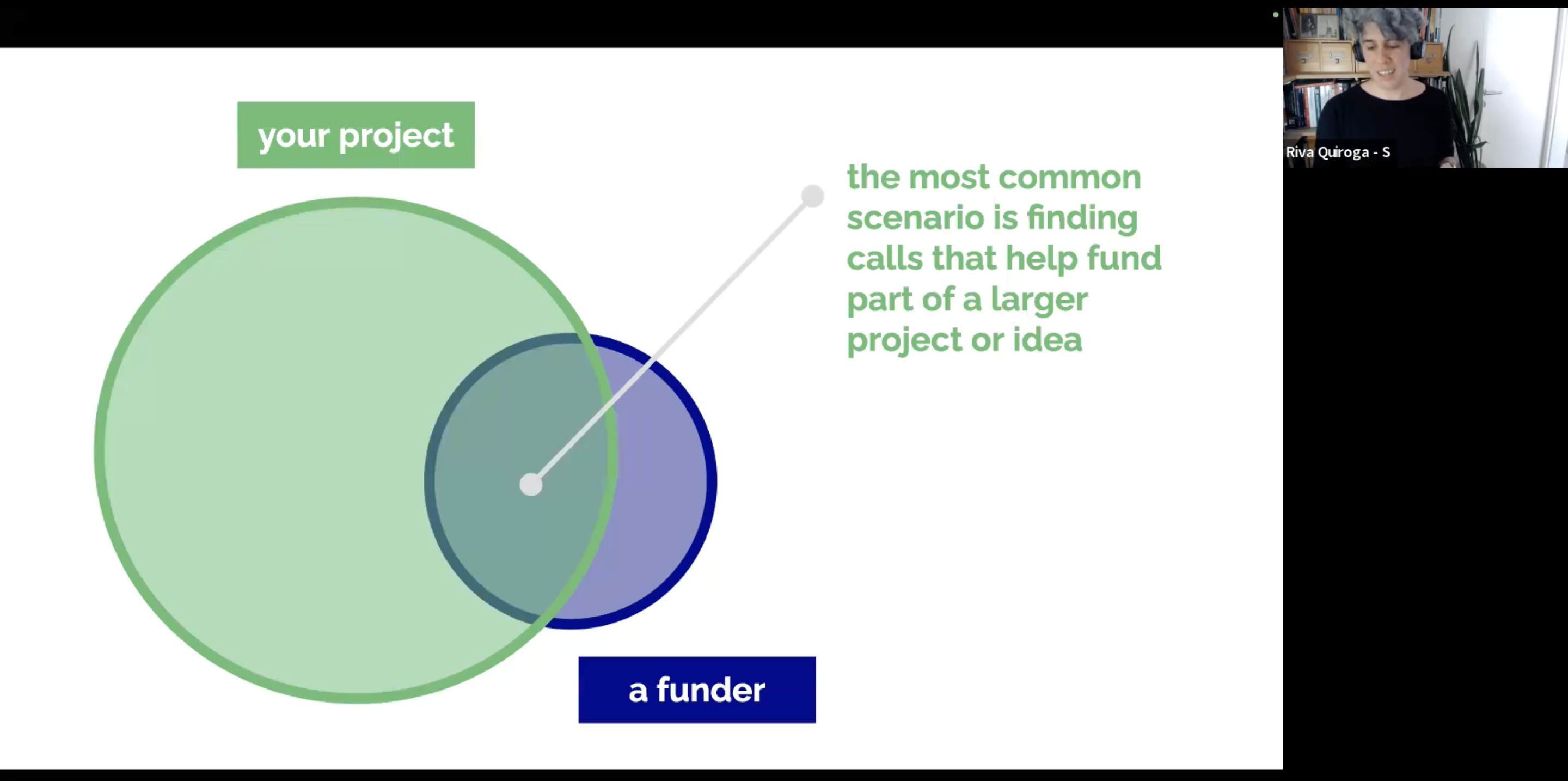
In this first part, participants had the opportunity to share their previous experiences applying for funding in small groups. A lot of useful advice was exchanged, such as how applying for travel grants for conferences can be a good first step towards becoming familiar with application processes.
One of the challenging aspects of learning how to be prepared for a call for proposals is that calls can vary widely in scope and format depending on the funder, and that a key part of the process is more about reading than writing. To illustrate this, in the second part of the workshop we used impact as an example of topics applicants are often asked to address in a proposal, but which can mean very different things depending on the funder or the type of call. After analysing different examples, participants worked on revising a short paragraph they had written before the workshop about the impact of their project.
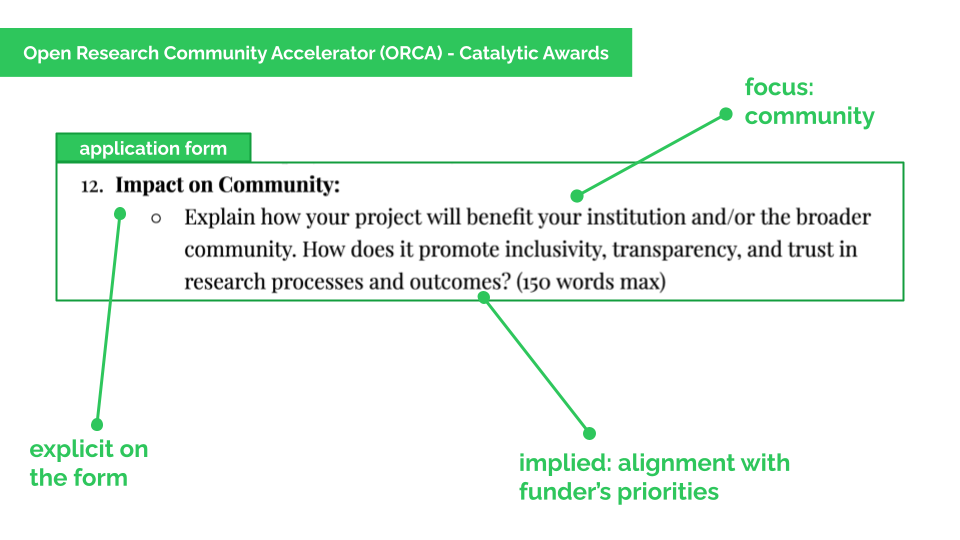
Then, after discussing what review processes usually look like, participants engaged in a peer-review exercise aimed at giving feedback on how well their description of impact aligned with the expectations of a specific call.
![Slide presenting a peer-review activity on giving and receiving feedback about an impact paragraph, shown with a speaker visible on screen. The instructions guide participants to exchange and assess their paragraphs using criteria that depend on the call they chose for the activity: impact on community, alignment with the funder’s strategic goals, or contribution to advancing knowledge or methods.]](/images/2025-12-18_elife-workshop-fig-3.png)
Finally, in the last part of the workshop, we went through different strategies and resources that participants can rely on to further develop their grant readiness, and we left some space to discuss the role of AI in the current landscape. We presented examples of how funders are currently using AI, and then opened the space for participants to share how they are using it. It was particularly refreshing to hear that some participants are very aware of the issues regarding data privacy in some platforms and shared examples of how they use their universities’ infrastructure to put safeguards in place.
![Slide titled “How funders are using AI,” listing four uses: applicant matchmaking for collaborative proposals, translation of multilingual applications, classification of proposals by topic, and matching proposals with reviewers.]](/images/2025-12-18_elife-workshop-fig-4.png)
We’ve made the workshop slides available on Zenodo, in case you want to dive deeper into the topics we covered.
Lessons learned
As always, there is no better way to learn about a topic than by teaching it. For us, running this workshop was a great opportunity to translate months of research into practice and to better understand how we can support this and other communities in the future. We are proud to have shared the first iteration of our Seeds to Systems curriculum with the eLife Ambassadors community, deepening our history of collaboration. We are also grateful to Ambassadors for their enthusiastic participation in the workshop and valuable feedback: there is a need for a practical curriculum beyond grant-writing. Stay tuned for more opportunities to both shape and participate in our training next year!