Power is important. It governs who gets to take decisions and about what, and who gets to benefit from the outcome of those decisions. In open research, we encounter issues related to power all the time: power dynamics can exist based on who has funding and who doesn’t; who has a stable position at a Global North institution and who is working precariously in a low-resource environment; who has lived experience of a particular condition or situation, and who has learned about it from books and papers. In fact, a lot of open research work seeks to rebalance power and to make all parts of research more accessible to those who might not otherwise have access.
To address power imbalances, however, we need to understand them. In my research work – first in human rights, and later in critical technology studies – there’s one framework I keep coming back to, as a way of being more thoughtful about what participatory research really looks like. It’s nearly 60 years old, but still resonates today.
Sherry Arnstein was a health and public policy specialist in the USA. Working at what is now the Department of Health and Human Services in the 1960s, she led the development of the strategy to desegregate all US hospitals, and worked on Lyndon B Johnson’s ‘War on Poverty.’ In 1969, she synthesised her experiences involving citizens and residents in decision-making into one framework: the Ladder of Citizen Participation1.
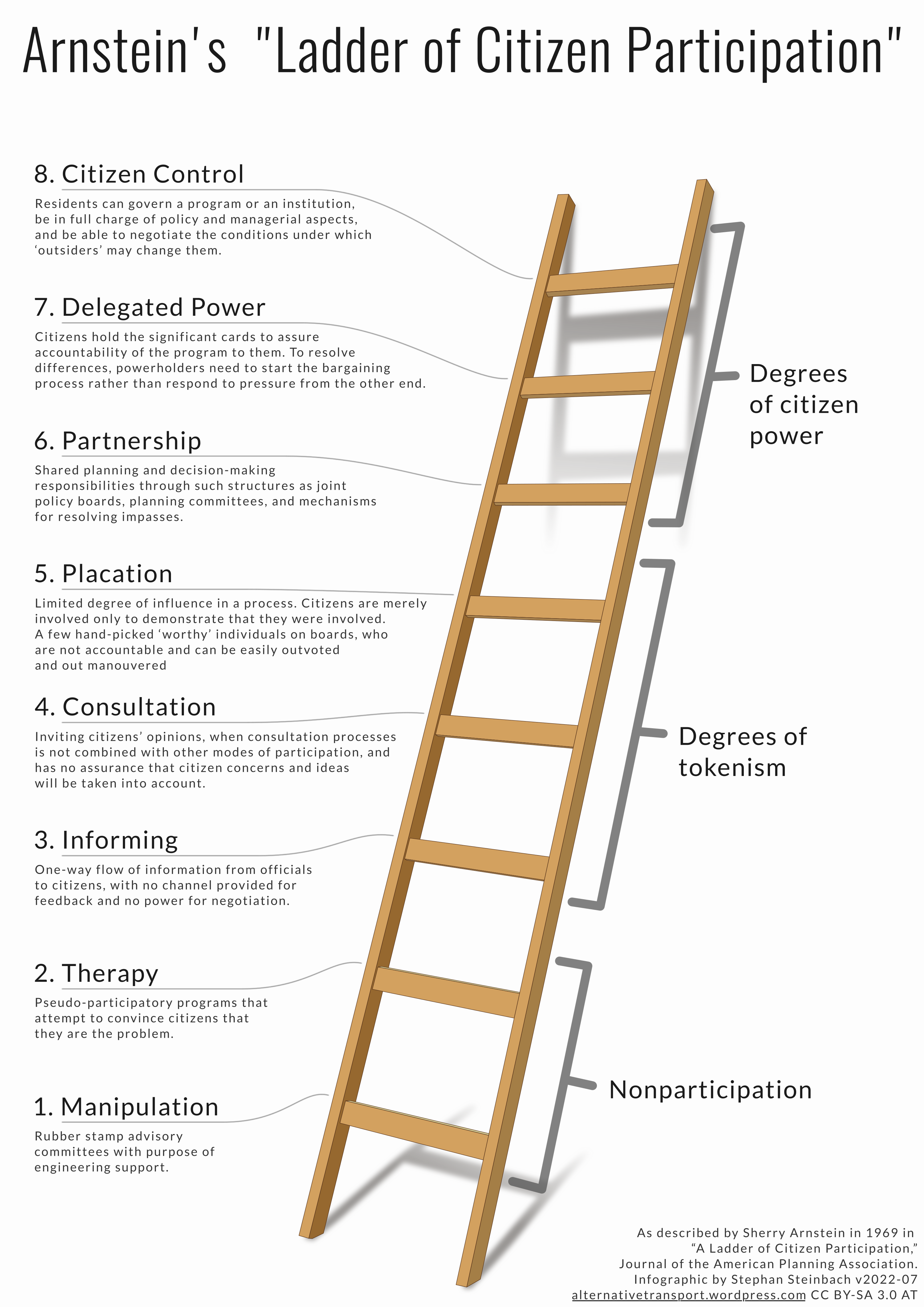
In her article, Arnstein draws on concrete examples from the US policy context to illustrate that ‘participation’ in decision-making can mean a wide swathe of activities: some of which rebalance power, and some of which merely cement existing hierarchies. At the bottom of her ladder is ‘participation’ that is in fact not participatory at all: where individuals are involved in decision-making processes only to rubber stamp decisions that have already been made, or are asked to participate in activities designed to change them, not unjust power dynamics.
Further up the ladder is tokenism: people are informed of decisions only after they have already taken place, or asked for their opinions through surveys and public hearings with no guarantee that these opinions will be taken into account when decisions are made. At most, participation may be placatory: a small number of people may sit on decision-making bodies (where they can be outvoted) or may be put on their own committees or working groups to ‘advise’ the groups that actually take the decisions: again with no guarantee of impact.
At the top of the ladder are what Arnstein termed ‘degrees of citizen power:’ working partnerships between decision-makers and citizens, and delegated power where public groups have successfully assumed responsibility for some decisions. At the top: citizen control, where the participants have full power over all decisions that are made.
Arnstein was drawing on her experience in city and community planning exercises, where she observed most of these ‘rungs’ on her ladder first-hand. But her ladder is much more widely applicable, which is why her article has been continuously reprinted and translated since its publication. Though Arnstein herself acknowledged that real participatory processes are more complicated than 8 simple positions, and that neither decision-makers nor the populations they serve are homogeneous groups, the ladder still serves as a useful guide for those of us who seek to make our work ‘more participatory.’ What ‘rung’ of the ladder are we actually aiming for, and what have we actually achieved? How much power are we willing to cede to our participants?
-
Arnstein, S. R. (1969). A Ladder Of Citizen Participation. Journal of the American Institute of Planners, 35(4), 216–224. https://doi.org/10.1080/01944366908977225 ↩