Seeds to Systems is a cohort-based training and mentoring programme centred on organisational infrastructure for the sustainability of open research projects and communities. Each week, we share what the cohort sessions covered and some insights and questions they raised.
This week’s sessions
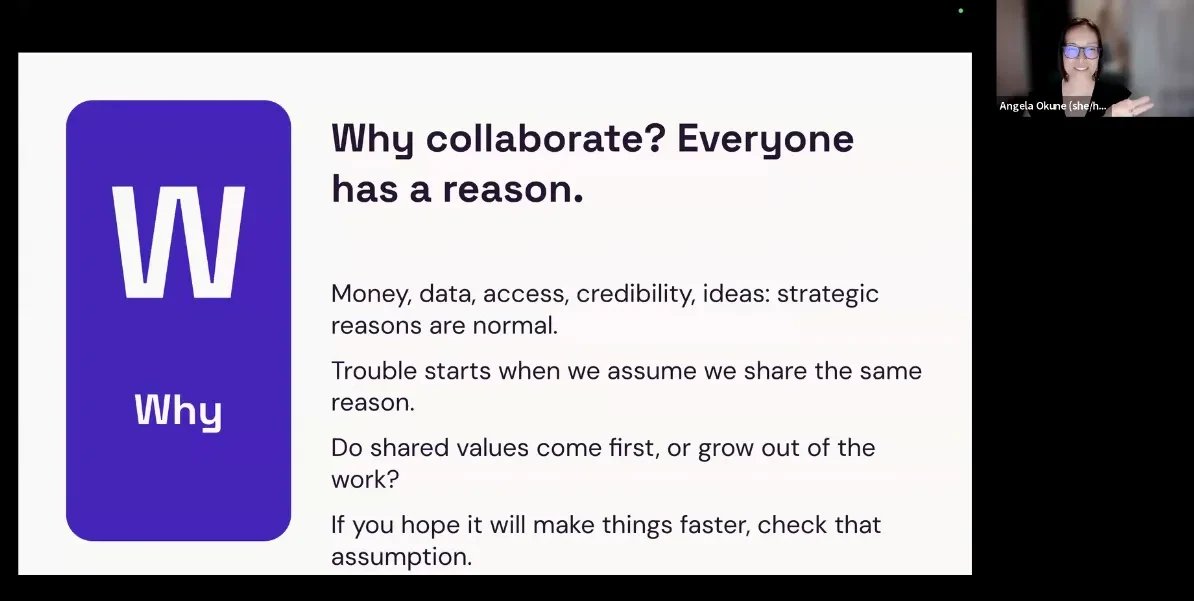
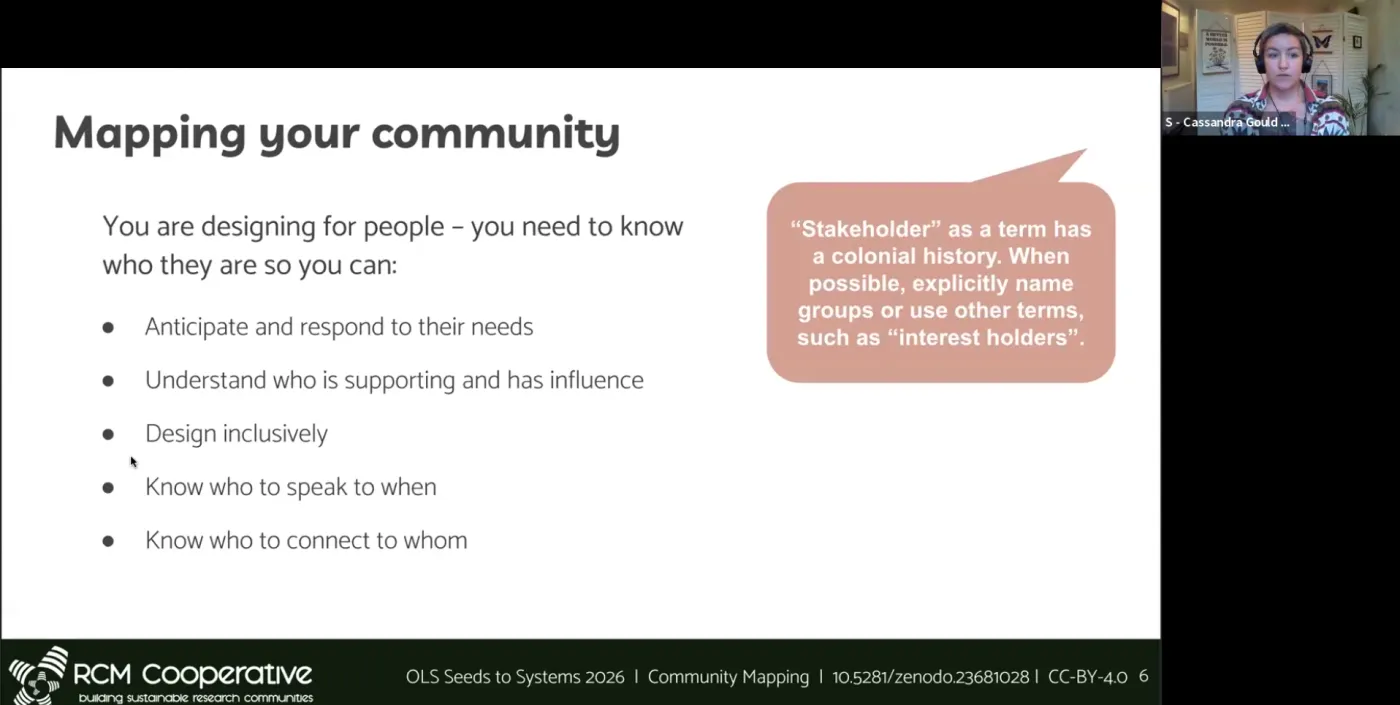
- Session 3: Collaborations and community mapping: With Angela Okune, we explored how the word “collaboration” can hide very different expectations, and how naming them can help teams build agreements they can revisit as the work changes. Cassandra Gould van Praag then introduced community mapping as a way to understand who is part of a project, how people are connected, and where to focus engagement.
- Session 4: Equity and collaborations panel: Batool Almarzouq invited us to rethink how equity is addressed in open science, looking beyond charity-based approaches to question how research funding is structured and who benefits from it. In a panel that followed, Alexander Martínez (LA-CoNGA Physics and EL-BONGÓ Physics) and Rowland Mosbergen (Equersa) shared their experiences of building collaborations and partnerships across different contexts.
Insights and emerging questions
Many of this week’s conversations were about things that usually go unsaid. In our session on collaboration, “collaboration” turned out to be one word holding very different expectations about time, credit, data, or who decides. When these remain unspoken, each person fills the word with their own meaning, and a collaboration can drift even when everyone involved has good intentions. Naming these assumptions, writing them down, and revisiting them as the work changes can help, but it also takes time: collaboration rarely saves time, and it needs room for building trust and reaching agreements. Community mapping raised a similar point from another angle. In many communities, only one or two people hold most of the knowledge about community members, their work, and who to connect with. Making that knowledge explicit makes it transferable, so it does not disappear when someone leaves, and helps distinguish connections that exist on paper from those where people actually work together.
Our second session this week turned to what is rarely said about research funding itself. Equity in open science is often discussed in broad terms, and inequity is framed as a lack of resources or skills, which leads to responses based on aid or capacity building. The session invited us to look instead at how funding is structured and who benefits from it: the money that funds open science is itself part of a wider economic system, and interventions that do not question that system, including openness itself, can end up reproducing the inequities they aim to address. Moving from charity-based to justice-based approaches means making these structures visible and asking who gets to produce knowledge, whose knowledge counts, and who decides. The panel brought some of these ideas into practice, from designing collaborations together and sharing responsibilities from the start, to documenting work so a project can outlive the people involved, to protecting volunteers’ time and making sure decisions are made by people from the regions where the work happens.
These conversations also left us with some open questions:
- Do we know why each of our partners is collaborating with us, and do they know why we are?
- Do the people in our community know what information we hold about them, who can access it, and how we use it?
- Do our open science and inclusion practices challenge existing inequities, or work around them?
- In our collaborations across regions, whose knowledge and priorities shape the work, and where does that power come from?
Resources
Session recordings and slides will be published on the Seeds to Systems resources page. To go deeper into this week’s topics, you can also explore these links shared during the sessions:
-
Collaboration:
- Research Collaboration Agreement template (Okune, 2019)
- Partos Power Awareness Tool
- 4 Decision-Making Methods for Decentralised Teams (Bartlett, 2020)
- Toward a comprehensive theory of collaboration (Wood and Gray, 1991)
- A new form of collaboration in cultural anthropology: Matsutake Worlds (Choy et al., 2009)
- Global Health Research in an Unequal World: Ethics Case Studies from Africa (Aellah, Chantler and Geissler, 2016)
-
Community mapping:
- RCM-CRM, an open-source toolkit for mapping research communities
- On data privacy and protection
- Turing Environment and Sustainability Community Map
- UK TRE map participant information sheet, an example of a consent model
- Analyzing who is relevant to engage in environmental decision-making processes by interests, influence and impact: the 3i framework (Reed et al., 2025)
- Reimagining the language of engagement in a post-stakeholder world (Reed et al., 2024)
- Equity:
What’s next
Next week, we’ll reflect on what community infrastructure is, and explore the explicit and implicit values and structures that shape how decisions are made in our projects. We’ll also practise reviewing grant proposals, with a focus on recognising and reducing the impact of bias on our feedback.