Seeds to Systems is a cohort-based training and mentoring programme centred on organisational infrastructure for the sustainability of open research projects and communities. Each week, we share what the cohort sessions covered and some insights and questions they raised.
This week’s sessions
- Session 7: Funders panel & mid-cohort check-in: This week’s panel brought together Neil Chue Hong (Institute for Research Software) and Eunice Mercado-Lara (Open Research Community Accelerator (ORCA)), who shared their experience working in research funding organisations, how they have helped design funding calls, and what they look for when deciding funding priorities. As we reached the middle of the cohort, we closed the session with small group conversations organised around challenges that participants had identified for their own projects, such as recognising and retaining volunteers, decision making, demonstrating impact, and outreach.
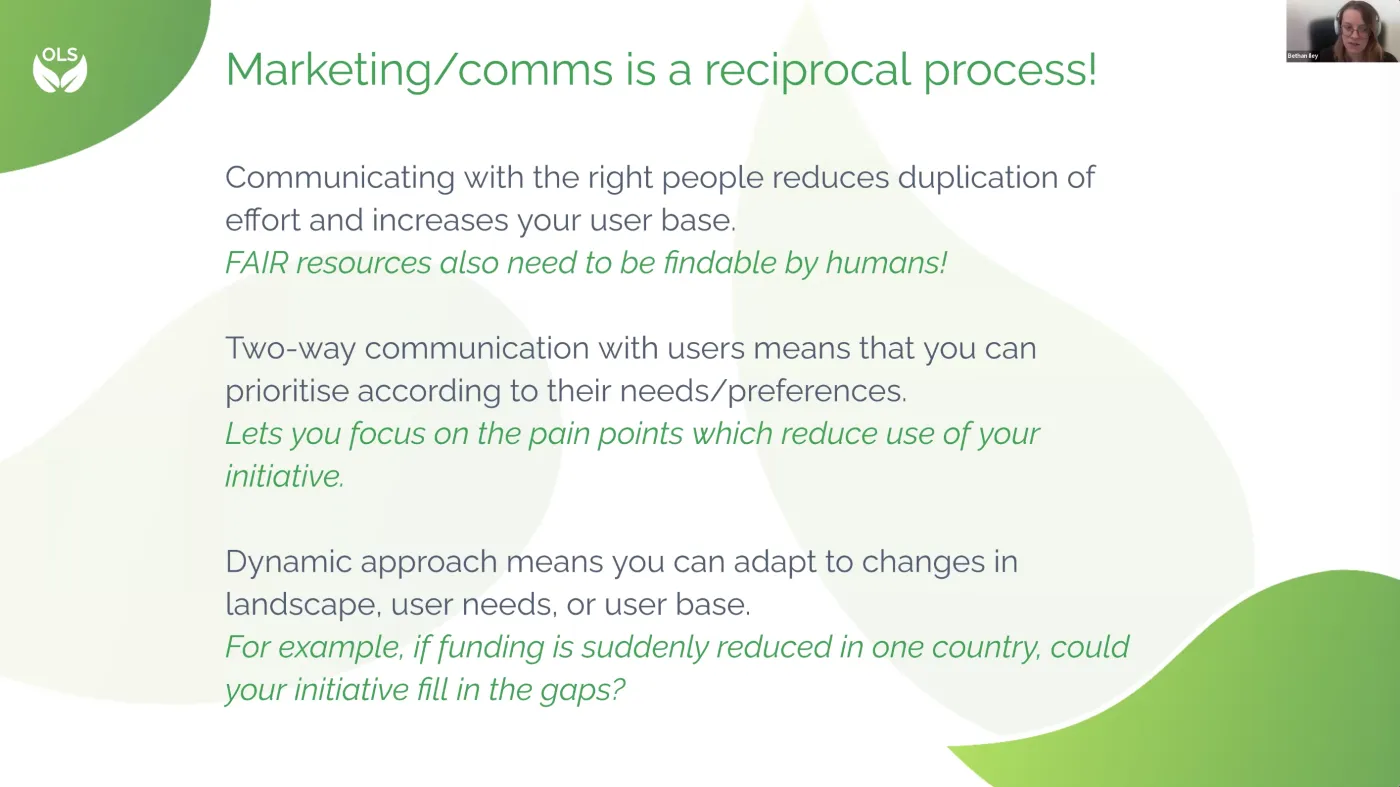
- Session 8: Outreach & impact: Outreach and impact feed into each other, so this session looked at them together. Bethan Iley (OLS) covered how to identify a project’s audiences and choose the channels to reach them, and why a marketing and communications plan helps share this work across a community or project. Gemma Turon and Inés Vicente (Ersilia) then introduced a framework for measuring impact, built around what a project wants to change, who the evidence is for, and how to collect it.
Insights and emerging questions
Applying for funding can feel like a black box, and hearing from people who design and manage funding programmes helped us see what shapes their decisions. As Eunice Mercado-Lara put it, funding is a bet. Both panellists described how funders also have to justify their decisions, to a board or a public body. Neil Chue Hong explained that most people who run funding programmes are not the ones who sign off budgets: they have to make the case for why an area deserves funding, and the reports and impact data that projects share are what allow them to do it. This is why a proposal needs to show more than a list of activities. In Eunice’s words, funders “buy theory of change”: they want to understand how a project’s activities will lead to the change it wants to make. Both panellists stressed the role of storytelling. For Neil, funders and reviewers respond to stories, and a proposal that rises to the top needs a strong project, a strong narrative, and evidence of why it should be funded. Eunice added that funders can see a team’s passion for its work, but what makes the difference is translating that work into outcomes, and those outcomes into a story that a funder can be excited to report on. This is also why funders value projects that plan from the start how they will know whether they succeeded.
The panel also helped us think about what a rejection means. Neil explained that many funding calls receive more good proposals than they can fund, so luck plays a part in which ones are selected: final rankings can depend on small differences between reviewers. In other words, a rejection does not mean that a project is not worth funding. Eunice added that a rejection often reflects a funder’s strategy and the limited money available in each round, so it is not something to take personally. For her, a “no” can be treated as information: funders rarely share feedback by default, but asking for it can mean receiving the external reviews. She also reminded us that submitting proposals is itself part of the practice of getting funded, and Neil encouraged reapplying, especially after good feedback, since reviewers usually change from one round to the next.
Beyond any single application, both panellists shared ways in which projects can build towards funding over time. Eunice suggested starting small and delivering well: smaller grants can build trust with funders and show that a project can deliver, which makes it easier to ask for more funding later. She also recommended finding out what a funder usually awards for projects like yours, for example by looking at past grantees. Building relationships with funders came up in both talks. Eunice clarified that these relationships should not be transactional, since funders can tell when interest is not genuine. They can start when a project and a funder care about the same problems, ideally before a call opens, and town halls, webinars, and office hours, where programme officers answer questions, are a good place to begin. For Neil, these relationships help projects understand a funder’s mission and current goals, and whether it is the right funder for their work at that moment. He also recommended taking part in review panels, as reviewer or observer, to see from the inside how funding decisions are made.
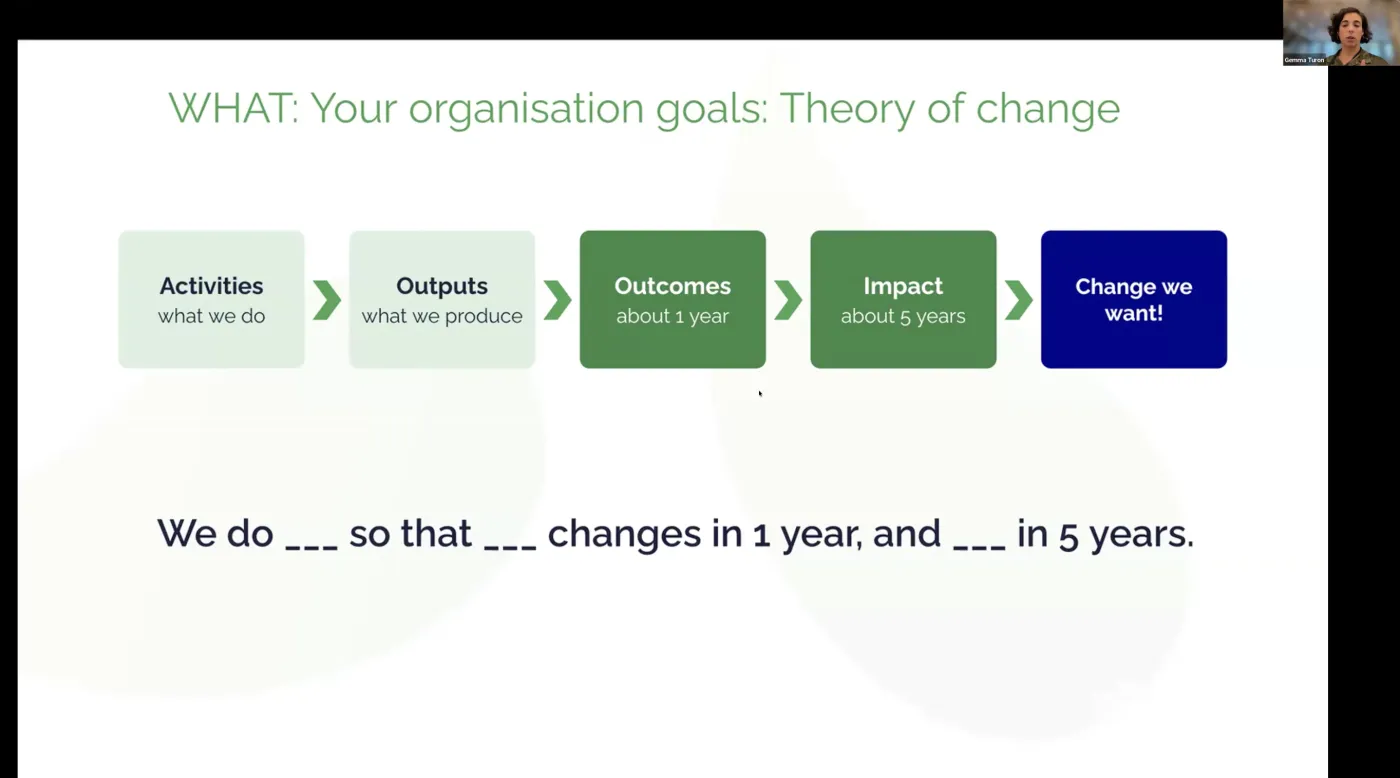
If funders look for a clear story about the change a project wants to make, our second session this week looked at how projects can define and measure that change. Gemma Turon and Inés Vicente, from Ersilia, proposed three keys for measuring impact: what a project wants to change, who the evidence is for, and how it will be collected. The “what” can be organised as a theory of change that connects what a project does (its activities and outputs) with what changes as a result (its outcomes, in about a year, and its impact, in about five years), or in short: “We do ___ so that ___ changes in 1 year, and ___ in 5 years.” Separating these levels matters because outputs are not impact. Outputs are often easy to count, and some of the numbers projects usually collect are what are known as vanity metrics: they make a project look good, such as the number of followers or website visits, and tend to keep growing whether or not anyone benefits. The “who” also shapes what is worth measuring, since each audience needs different evidence. A project itself needs to know what to change or improve, funders whether it is worth investing in, partners whether the relationship is working, and the people it serves whether it is really helping them. As for the “how”, not all evidence is equally easy to collect. Counting downloads or attendance is simple, while knowing whether people apply what they learned in a training programme, or whether their institutions change years later, depends on others and is much harder to track. A whole project is usually “too big to measure all at once”, so the suggestion is to break it down into activities, each with its own outputs, outcomes, and impact. Working at this level makes measurement more manageable, and it also makes it easier to see what is working and what is not, something that is hard to tell when everything is measured together. It also helps to start with the metrics a project knows it can collect, and build up to more complex ones over time.
Earlier in the same session, Bethan Iley from OLS described outreach and impact as a cycle. A project’s outputs, outcomes, and impact create content for its outreach, and outreach, in turn, makes that impact visible. In practice, outreach can include much of what a project does to let people know it exists and why it might matter to them. Take a project that offers a free, open source tool: people can only start using it, or get involved, once they know it exists. Many research projects are already doing some of this, through a newsletter or conference talks, for example, even without calling it marketing, a label many of us may feel uneasy with because it can sound like selling something. Outreach also works in both directions. Along with sharing what a project does, it means listening to the people it wants to reach, for example by replying to comments or asking for feedback. Listening helps a project understand what people need, and notice early when something around it changes. Because outreach takes a lot of time, it helps to plan it. A project can start by deciding who it most wants to reach, and then focus on the one to three channels where those people are most active, instead of trying to be everywhere. Writing these decisions down in a marketing and communications plan means that anyone in the community can pick up communications and spread the load. This avoids a situation that has come up in several of our sessions, where work that depends on specific people is put at risk when those people become unavailable.
These conversations also left us with some open questions:
- If building relationships with funders matters, how can projects without strong networks or connections get a fair chance?
- If funding is a bet on who can show they will deliver, how do new projects get their first chance?
- If the impact we care about most is also the hardest to measure, what do we lose by focusing on what is easy to count?
- When the changes we hope for take years and depend on many others, how can we tell what part our work played?
- How many collaborations might our project be missing, and how much work might be duplicated, simply because others do not know what we are doing?
- When time is short, where does outreach fall among our priorities, and what does that choice cost us?
Resources
Session recordings and slides will be published on the Seeds to Systems resources page. To go deeper into this week’s topics, you can also explore these links shared during the sessions:
- Promoting Transparent, Fair, and Inclusive Practices in Grantmaking: Lessons from the Open and Equitable Model Funding Program (Mercado-Lara, Tananbaum, & McKiernan, 2024)
- Catalytic Awards Program Round 1 Report - What We Learned (Mercado-Lara, 2026)
- Better Software Funding, Better Research Software? What we’ve learned from the Research Software Maintenance Fund and what you should know about getting funding for software development (Chue Hong, Roubickova, Barclay, Peru, Glass, Aragon, & Guo, 2026)
- Research Software Maintenance Fund: full application funding panels completed (Chue Hong & Aragon, 2025)
- Partially Randomized Procedure - Lottery and Peer Review (Volkswagen Foundation)
- Funding lotteries for research grant allocation: An extended taxonomy and evaluation of their fairness (Feliciani, Luo, & Shankar, 2024)
What’s next
Next week, we’ll look at the many costs involved in sustaining a project, and how they can be reflected in a budget. We’ll also approach grant writing through the lens of grant readiness, bringing together the topics we’ve explored throughout the cohort.